Want to Read
Sign in to build your shelf
Get the book
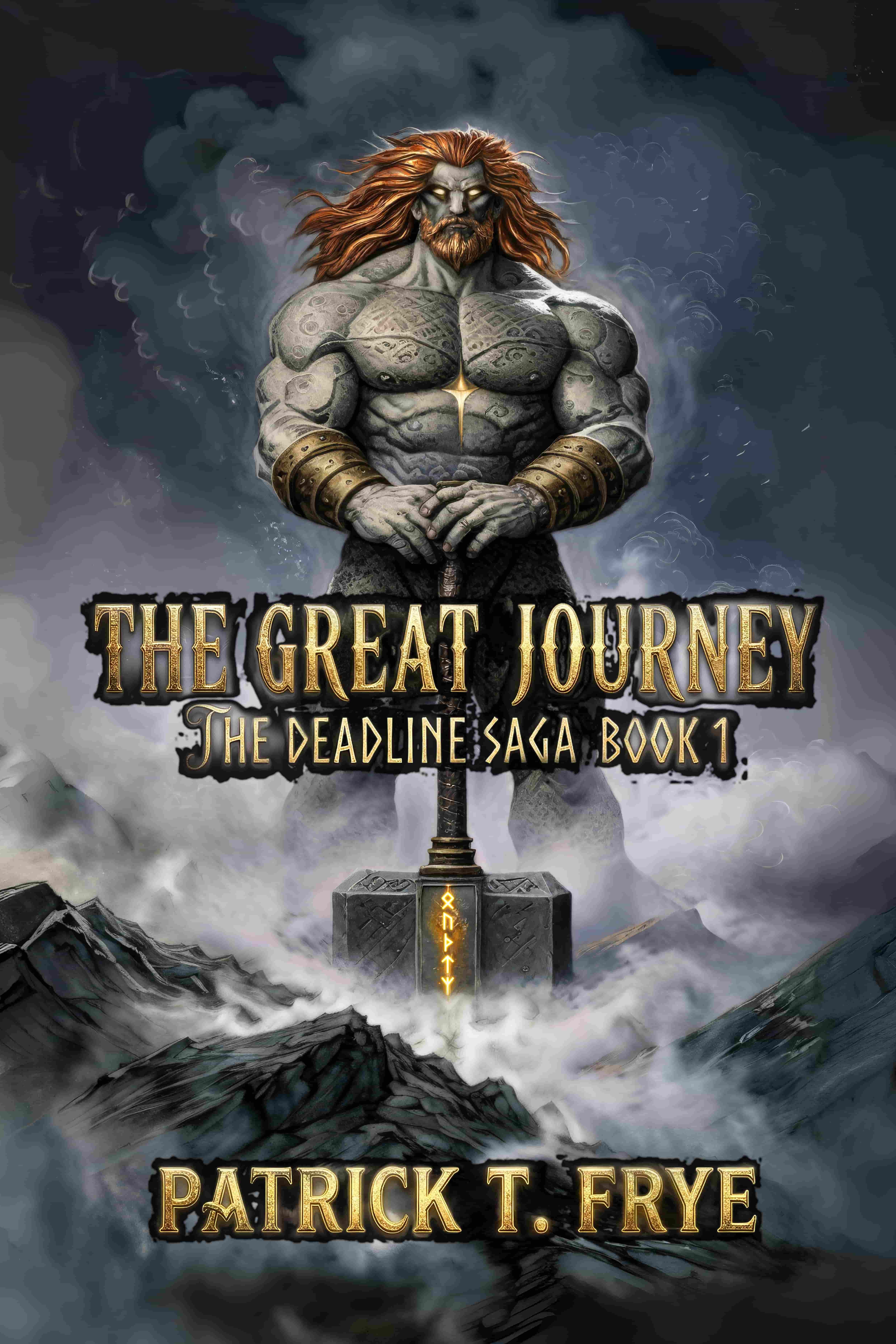
The Deadline Saga · Book 1
 by Patrick T. Frye
The Great Journey
by Patrick T. Frye
No reviews yet. Be the first.
Deadlines burn bright.
The Arbiter heralds judgment.
Countdowns signal death.
Pierce the Veil.
Everyone lives beneath a burning deadline. A clock of fire hangs over every head, counting down the years, the days, and, for some, the final hours before they turn to ash.
Juno Laval has spent his life at Helion Orphanage trying not to look too closely at the number above his own head. He tries not to look at the Veil either, a wall of living fog wrapped around the feet of the Arbiter. The towering stone giant waits at the edge of the world, where Juno’s brother vanished.
Chosen for the Great Journey, Juno is sent beyond the walls with Orphan 8, a squad of gifted young fighters as reckless as they are deadly. Across a broken world of cursed biomes, monstrous Corruptions, and dwindling hope, they must hunt for Essence, survive the wilds, and press ever closer to the Veil before more lives are lost.
But the farther Juno travels, the more dangerous the questions become. And beyond the Veil may lie the brother he thought was gone forever.
- Type
- Novel
- Format
- Ebook, Audiobook, Paperback, Hardcover
- Published
- May 2026
- Pages
- 287
- Language
- EN
- ISBN
- 978-1-960735-25-6
Content rating
Author-supplied. Hover a meter for the rubric.
- Language
- 1/4
- Violence
- 3/4
- Romance / Sex
- 1/4
- Biblical Themes
- 3/4
rare, soft words
graphic injury/death
flirting only
prominent faith themes
Author note: Language is very mild. There is little conventional profanity, with the characters relying more often on insults, teasing, fantasy terminology, or implied swearing. For example, a sister calls her brother a "Lunkhead." In the same scene, another boy jokes that the brother has the hygiene of a boulder and can "see moss growing under his arms". Strong profanity is absent because the narrator (the story is told through the eyes of the protagonist, Juno Laval) will describe any such instances as “swearing softly under their breath” without spelling out the profanity.
Violence is moderate to intense, with frequent fantasy combat, frightening monsters, character deaths, injuries, blood, and sustained peril, although graphic gore is limited. Characters fight monsters called Corruptions using blades, fire, lightning, ice, and other supernatural abilities, and the threat of sudden death from the ever-present deadlines remains central to the story. One disturbing sequence involves the discovery of a man who has been shot through the chest by a hidden monster that is stalking people. Later, the protagonist witnesses a mortally wounded man coughing wetly as the healer desperately tries to save him before he dies in front of them. Other battles include unearthly creatures being stabbed, shattered, burned, or otherwise killed, such as a non-human character driving a crystal spear weapon through a monster called a Glassheart and shattering its armored body into pieces.
Romance is very mild, with no sexual content. The story is a no-spice, slow-burn romantasy that primarily establishes the beginnings of romantic tension through friendship, teasing, emotional intimacy, and occasional embarrassment rather than an established romance. For example, after the death of a mother figure, the main female character, Sera Dune, runs to the protagonist and hugs him tightly. Other people in the room smile knowingly, and the protagonist turns away afterward because his face is burning with embarrassment. A telepathic connection called a Flowbond allows the characters to voluntarily share emotions and thoughts. In several unguarded moments, it is implied that the main female character is admiring the physique of the protagonist. The closest that a scene comes to sexual content is when a male character complains about desert sand chafing him between his legs after days of marching, and several of the girls in his squad ruthlessly mock him. His sister remarks, “Don’t you know girls have it worse, Rockhead?” Otherwise, there are no sexual situations, sexual discussions, or sexually descriptive passages. Even my teenage boy readers, who generally don't like romance, enjoyed the story.
Biblical themes are prominent and generally presented positively, particularly sacrifice, faith, moral responsibility, service to others, and pursuing what is good despite personal cost. The culture of the Journeymen repeatedly emphasizes the creed “So others may complete life’s journey,” presenting self-sacrifice for others as one of its highest virtues. A particularly direct biblical parallel occurs when Sera explains why she is willing to sacrifice her safer future to help the protagonist and his friends, saying that if she knows the good she ought to do and refuses to do it, that failure would be a mortal sin. The statement closely parallels James 4:17 and frames her decision to join the Great Journey around a moral obligation to act when she has the ability to help others. Prayer, the Creator, heaven, doctrine, and religious instruction also appear naturally throughout the fantasy setting.
Vibe & themes
What this book is like. Log in to confirm these or flag ones that don’t fit.
Tone
Hopeful
Epic
Quirky Humor
Tropes
Found Family
Slow-Burn Romance
Orphaned Hero/Heroine
Friends to Lovers
Themes
Coming of Age
Survival
Sacrifice
Setting
Secondary/Other World
Post-Apocalyptic
Point-of-View
1st person present
Pace
Steady
Log in to confirm these tags or flag ones that don’t fit.
Reader reviews
No reviews yet
Be the first to share what you thought.
Discussion
Start a discussionNo discussions about this book yet. Start the first one.