Author Interview with Richard Paolinelli
By Spotlight Admin
Welcome to the Spotlight on Indie author interviews! Our featured author for this interview is Richard Paolinelli…
He is an award-winning author of science fiction, space opera, fantasy, mystery, and suspense. A storyteller since 1984, Richard combines imaginative world-building, compelling characters, and gripping plots to deliver unforgettable reading experiences. His science fiction novel Escaping Infinity was a finalist for the 2017 Dragon Award for Best Science Fiction Novel. His diverse body of work also includes the Starquest 4th Age series, mystery novels, Sherlock Holmes adventures, and nonfiction sports books. As the Publisher, and co-founder, of Tuscany Bay Books, Richard continues to bring imaginative stories and exciting new adventures to readers who love science fiction, fantasy, and mystery.
SPOTLIGHT: Now that we know something about you, could you provide a summary of what you would like readers to know?
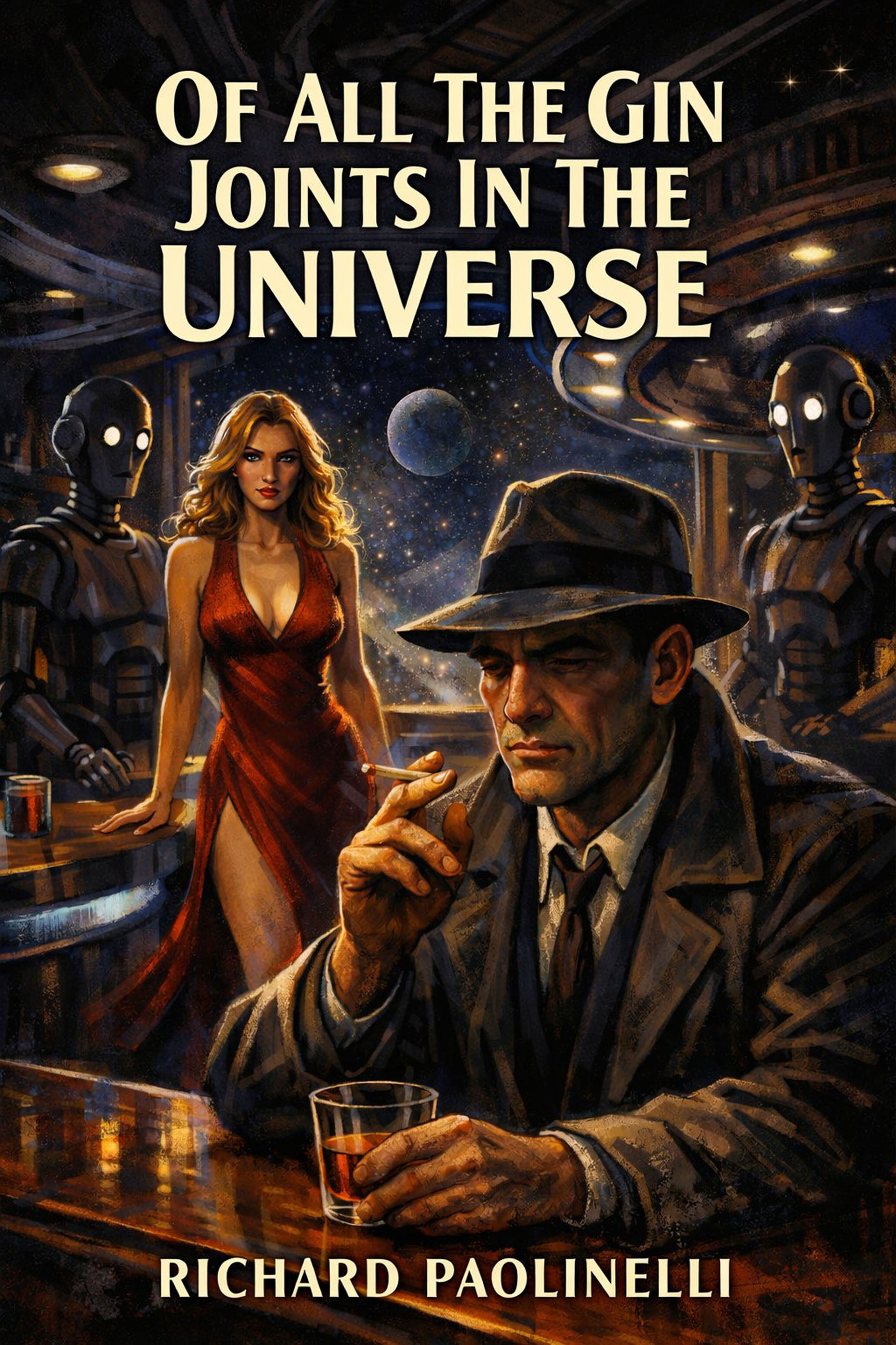
RICHARD: My last novel, Of All The Gin Joints In The Universe (Space Detective Noir), has a very interesting story about how it came to be. I hadn't planned on writing it until a chance online conversation with another author sparked the idea.
The main character is Samuel Archer Spade, a private eye on a space station on the other side of the galaxy. The femme fatale is Natasha Carter (named after the author who sparked this insanity in the first place), a character that was a lot of fun to create.
The real protagonist of the story is the HALO device, as much as the people using it for evil purposes. Erasing people and replacing them with a new personality was a theme I wanted to tackle, especially in light of current tech that is linking the human brain directly to a machine for the human to control. How much harder would it be for the machine to take control of the human brain?
SPOTLIGHT: Erasing personalities and installing new personalities sounds like an idea used in Babylon 5 or a later episode of Stargate SG-1. Did either of those have any influence on your idea or what other sources inspired it?
RICHARD: It was definitely inspired by that episode in the first season of Babylon 5. I’d wondered, after that episode first aired, what would happen if that technology was ever used wrongly, or even for evil purposes. There’s a novel by Jack McDevitt that has a character that erases herself, and permanently replaces herself with a new personality to help hide a secret. They both definitely influenced what I did in Gin Joints.
SPOTLIGHT: What does HALO stand for? (Is it an acronym?)
RICHARD: I actually started to try to work out what the acronym would be and then said to heck with it. HALO just had such an ominous sound to it in the context, and it accurately described what the device looked like when in use.
SPOTLIGHT: How does HALO work? What is it designed to do?
RICHARD: It’s a ring that is place on a subject/suspect’s head. When activated, it glows like a halo, and forces the wearer to answer all questions truthfully. It was designed to remove any and all doubt as to the guilt or innocence of the wearer. If guilt is confirmed, the wearer remains under the device’s control until their personality is erased and a new personality is installed to begin a new life to better serve society.
SPOTLIGHT: Who developed HALO and who is trying to misuse it, or who are the suspects?
RICHARD: It’s a descendent of Elon Musk, and I chose Elon specifically because of Neuralink, who develops the HALO and originally it was for a good purpose. I personally have an issue with putting implants in the human mind and linking them to a computer. How easy would it be to program a human mind via such a link?
That’s the theme I wanted to explore in this book. As for who is misusing it, that would be elements within Galactic Justice who see a way to control humanity, rather than just police the wrong-doers. There are multiple suspects.
SPOTLIGHT: What inspired you to write Of All the Gin Joints in the Universe or set up that world? Do you have a leaning towards noir mystery?
RICHARD: I’d always wanted to write a detective noir story set in space but I never really developed an idea for it. I’m a huge fan of the 1940s detective noir films, especially Humphrey Bogart’s films in the genre.
Then one day a fellow author, Natasha Carter, dropped a post over on Twitter and my smart-aleck reply triggered the opening scene of the story. I thought it was just going to be a one-off short story and done.
Next thing I knew, I had a full-length novel on my hands.
SPOTLIGHT: Could you describe the setting/worldbuilding you have in this novel?
RICHARD: It's set in the 25th Century on a space station on the other side of the galaxy. Eventually, it moves to Mars and to an Earth that had been all but abandoned just before a massive meteor strike rendered the planet uninhabitable – allegedly.
The human race inhabits every corner of the Milky Way, and is preparing to head for the Andromeda Galaxy, and the central government is now on a terraformed Mars. Galactic Justice (GalJus) is the law enforcement arm of the government, and has been quietly taking over the civilian government of Mars and on every other planet.
Samuel Archer Spade is a former GalJus Inspector who left to become a private eye as far away from Mars as he could get once the HALO was put into operation.
SPOTLIGHT: Could you tell us a bit more about your main character in Gin Joints? Maybe a little of his past, his personality, why he left GalJus, anything that isn't too spoilery?
RICHARD: The main character is Samuel Archer Spade, his father chose his first and middle name as he was a huge fan of the old 1940s Detective Noir films and the family name is Spade. Growing up, he watched the old films with his dad and ended up gravitating toward a career as a cop.
He is very much the wise-cracking Sam Spade/Phillip Marlowe private detective. A strong sense of right and wrong but the ability to know when, and how far, to bend the rules to get justice done.
He leaves GalJus shortly after his first usage of the HALO, seeing early on how an irreversible error could occur, not to mention the intentional misuse of the device. Not wanting to be a part of that, he left GalJus and set up shop as a private investigator on Norma, (aka Station 1964) as far away from GalJus HQ as he could get and still be in the galaxy.
SPOTLIGHT: How does he get involved in a case involving Natasha Carter? Can you share anything of why she comes to him?
RICHARD: Natasha shows up on Norma looking to hire Sam, claiming she is being stalked by a man over a museum piece. When the man arrives on Norma, he tells Sam that she has stolen said item from him. As Sam digs deeper, he finds a more sinister web of lies leading all the way back to GalJus.
As for the why she comes to him, that would be spoilers, no matter how hard I tried to keep it vague. Sorry…
SPOTLIGHT: Don't worry about it. I don't want to give away any spoilers. Readers will have to read the book to learn more.
You have other books besides Of All the Gin Joints in the Universe. Please tell us about them—Starquest and Seadragon—characters, settings, conflicts, etc.
RICHARD: The three novels that make up the Starquest 4th Age Saga are directly connected to John C. Wright’s Starquest Universe and serve as something of a prequel series to his novels. I wanted to create something of a bridge between the evacuation of humanity from the Milky Way and set the stage for the events to come in John’s books. With hundreds of thousands of years between the time of the 4th Age and John’s 12th Age, it gave me a lot of room to work with and not worry about violating any of John’s established canon.
Galen Dwyn is something of a Han Solo, with no doubt that he would shoot first, and is a man of destiny.
The character I enjoyed creating the most in this series was the snarky AI, Cassandra, who becomes a central player in the stories as much as the Princess Rhiannon. Dwyn finds himself as one man standing against an entire empire with the fate of humanity on the line.
As for Seadragon, that was my first fiction credit back in 1986. (Yes, I AM old, thank you for reminding me). It was a comic book series by Elite Comics, and I was the lead writer for the first two issues. I had a lot of fun with the character and always felt that it was cancelled (just six issues) before we could really get into the character. Fortunately, the creator of the series gave me the green light to make a novelization of it a few years back. Better yet, he loved how it turned out.
It follows Walter Koch, a Navy Seal testing an experimental suit. An accident fuses the suit to his body, almost replacing his skin. Koch ends up with the Epsilon Project and discovers a world of fantastic meta-humans and that two ancient cultures at the bottom of the oceans are about to resume an ancient war that could destroy the world on the surface.
SPOTLIGHT: What inspired you to start writing?
RICHARD: Writing just seemed to be a part of me, even early on. We moved around a lot when I was a kid, heading for the next drilling boom. There isn’t a lot to do when you’re jammed into a back seat with blankets and other stuff. So I’d write these little stories in a notebook as long as there was daylight.
Then I started writing freelance when I was 19, got my first fiction credit when I was 22, landed in newspapers at 27 and its been writing in one form or another ever since.
I’ve said this many times: I don’t write because I want to, I write because I simply cannot see myself doing anything else but writing.
SPOTLIGHT: How did you first publish your books?
RICHARD: I started out traditionally published. Got an agent, who got me a publisher and the first two books of the Del Rio series were first published that way. My first book was the top-selling book for that publisher within the first three months.
My agent decided to start charging a large amount of money to read manuscripts – even from her existing clients – and I got to noticing I was doing nearly all of the marketing and only getting 10% of what the books were selling for.
That’s when I went indie and I have never regretted that decision since.
SPOTLIGHT: What have you learned about self-publishing?
RICHARD: It isn’t for the faint of heart. And it isn’t just about getting a book formatted, slapping a cover on it, and moving on to the next project. There is a ton of marketing work, dealing with legal issues, like Anthropic stealing our books, or people pirating our books and selling them on illegal websites, etc. I’d say my workload is 95% publishing and 5% writing these days.
SPOTLIGHT: What made you decide to start your own small publishing company?
RICHARD: Back in 2017 I was co-hosting a live, one-hour radio show in Los Angeles about writers called The Writer’s Block with Jim Christina. Since we lived a few blocks away from each other, we would drive into the studio together. One night, Jim mentioned that we should combine our two imprints and branch out, publishing other authors as well besides just our own books. That’s how Tuscany Bay Books was born.
SPOTLIGHT: How did you settle on the name of your publishing company, Tuscany Bay Books? Is there a story in the origins of the name?
RICHARD: Oh wow, let’s fire up the Way Back Machine on this one.
Back in 2007, I had moved to Half Moon Bay, CA and was looking to work as just a freelance writer. I ended up doing a monthly magazine and needed a name for the publishing company. Since my family had immigrated to the US from the Tuscany region of Italy, I decided to merge the past with the present and called it Tuscany Bay Publishing.
When I decided to start publishing my own books, I kept the name as the publisher of my books. Then a couple of years later, Jim Christina and I merged our two imprints. His was Black Dog Publishing. When we did the merge, and were sorting out possible names, he said he loved the Tuscany Bay name – also being of Italian descent – and we settled on Tuscany Bay Books.
SPOTLIGHT: Could you tell us what it's like from both sides of the fence - being the author versus being the publisher?
RICHARD: Being a publisher is a massive time and energy suck. It really takes away so much from writing time and energy. As I mentioned earlier, the majority of my work day is usually devoted to publishing. Those rare times I can focus on writing are usually writing sprints, hoping to get as much down before the next publishing fire springs up.
As an author, when I am writing for someone else now, such as an anthology, I am more aware of the deadline the publisher has and why it matters to hit that deadline.
SPOTLIGHT: What have you learned as an author that has helped you as a publisher or vice versa?
RICHARD: Time management and being disciplined. With as many hats as I’m wearing on the publishing side, making sure I maximize the time I have and remaining focused on getting each task done quickly and completely.
SPOTLIGHT: What other books do you have available or are you working on?
RICHARD: I just wrapped up the Starquest 4th Age series and the standalone Seadragon novel. I also have the Del Rio mystery-thriller series and several other standalone novels.
I have a screenplay adaption of Reservations that is in development already, but I want to get more into screenplays, including original stories. So that's where my writing energy has been directed toward lately.
SPOTLIGHT: What do you have planned for future projects, as an author and for Tuscany Bay Books or even Tuscany Bay Productions?
RICHARD: We have a trilogy by Edward Willett, the third book of Lori Janeski’s The Carter Files, and the last three books of John C. Wright’s Starquest series scheduled for 2027 at Tuscany Bay Books. So we’ll be busy for sure.
As far as myself, oddly enough, I’ve gotten comfortable with Gin Joints being my last novel for now. Unless I come up with some idea out of the blue, I may just let that be my grand finale, especially as I had so much fun writing it. I’d rather go out on a high note like that.
But that doesn’t mean I’m done writing. I’m working on screenplays, both film and streaming series. I have one in development – the adaptation of Reservations – with Step By Step Productions. I have a streaming series that I just pitched to a producer and I’m waiting to hear back on. And I have a couple of other projects I work on when time permits.
As far as Tuscany Bay Productions, I’m thinking of adapting some of my short stories into some time of video format. Just how that happens I’m still sorting out. I may go animated using a couple of programs I’m familiar with. I might try to crowdfund for live action and hope I can find the right cast and crew. Or I may go full Anakin Skywalker/Darth Vader and try to do one or two using AI just to stir the pot because that’s what I do when I get bored, lol. (Ducks as the torches and pitchforks crowd comes for him.)
But, seriously, I don’t know yet how that will all play out and I’m nowhere near close to being ready to make any final decisions on that.
SPOTLIGHT: What would you advise authors planning on self-publishing or those considering submitting to publishers?
RICHARD: If you’re on the fence about which path to choose, the best way to decide is to understand that yes, if you go indie you get all of the money from your book sales. But you also get to do all of the work. And writing the novel is probably 5% of the work.
So if you are not ready to put in all of the time and money needed to get the book cover, have it properly edited, market it, navigate the platforms and their quirky requirements to get it listed on their sites, and at least a hundred other little things, then submit to an agent or a publisher. But understand, even then you’ll be doing most of the marketing yourself.
But, if you want full creative control over every aspect of getting your book into the hands of a reader, and you are willing to grind at this for a long time before getting close to breaking even, then go indie. You won’t regret it.
Thank you, Richard, for sharing all that with us! You're a busy man and I appreciate you taking the time to answer some questions.
Readers can find more about Richard Paolinelli and his books at spotlightonindie.com/authors/richard-paolinelli and more about him and Tuscany Bay Books at the links below:
IMDB Page: www.imdb.com/name/nm14185795
Author Website: www.scifiscribe.com and www.richardpaolinelli.com
Tuscany Bay Books Website: www.tuscanybaybooks.com