Who's Buying the Books? (guest post)
By Spotlight Admin
~Guest post by Daniel P. Riley, Whimsyland Literary Coaching and Services
Every few months, somebody writes that men have stopped reading novels. The number they reach for is almost always the same one: women buy 80 percent of the fiction, and men buy what's left. I've seen that figure in newspapers and on blogs for years. It sounds clean. It sounds like a verdict.
Here's the problem. It doesn't hold up.
When Constance Grady at Vox went looking for the surveys behind that 80-20 split, she couldn't find them. Circana BookScan, which tracks print sales in the United States, told her they don't even break their data out by gender, and that 80 percent "seems quite high." Nielsen BookData, which does track buyers in the United Kingdom, said the idea that men account for only 20 percent of fiction "has never been the case, at least for the UK." The earliest versions of the claim trail back to old newspaper speculation and a deleted blog post. That's not a study. That's a rumor that learned how to dress like one.
So what do the numbers actually say?
Who's reading
Start with America, and start with the difference between "reads a book" and "reads a novel."
Pew Research Center asked Americans in 2021 whether they had read a book in any format in the past year, print, digital, or audio. Seventy-eight percent of women said yes. So did 73 percent of men. That is a real gap, but it is a modest one. Over the decade Pew has been asking, the picture stays roughly the same: most women read at least one book a year, and most men do too. The typical American, man or woman, is not a heavy reader. The average is about fourteen books a year. The median is five. A few people who read stacks of them pull the average up.
The National Endowment for the Arts asks a harder question. Their Survey of Public Participation in the Arts looks at reading for pleasure, not whether you cracked a manual for work. In the twelve months before July 2022, only 48.5 percent of U.S. adults had read a book for pleasure, down from 52.7 percent in 2017 and 54.6 percent in 2012. Women still outpaced men, 56.6 percent to 40 percent.
The fiction gap is wider, and it has been for a long time. In 2022, 46.9 percent of women had read a novel or short story in the previous year. Only 27.7 percent of men had done the same. That is just over a nineteen-point spread, almost identical to the spread in 2012, when the figures were 54.6 percent of women and 35.1 percent of men. Both sides are reading less fiction than they used to. The gap did not open yesterday. It was already there, and both lines have been sliding down together. Sunil Iyengar at the NEA put it plainly: roughly one in four American men read a novel or short story in 2022, compared with fewer than half of all women. The overall fiction-reading rate, 37.6 percent of adults, was the lowest since the NEA started asking in 1992.
If you add poetry and plays and call the whole pile "literature," the 2022 numbers are 49.2 percent of women and 29.5 percent of men. The drop since 2017 was steeper for men.
Time spent with a book tells the same story in minutes. The Department of Labor's 2023 American Time Use Survey found women spent about nineteen minutes a day on leisure reading. Men spent about twelve.
One more detail from the NEA that usually gets left out: the gap shrinks or disappears in some categories men are supposed to own. Men and women read graphic novels at almost the same rate. Science and technology books were the one nonfiction category in 2022 where men outread women. The stereotype that men don't read at all is lazy. The more accurate sentence is that men are less likely to pick up a novel, and fewer people of either sex are doing that than a decade ago.
Who's buying
The United States does not publish a clean, current split of book purchases by gender. That is why the 80 percent figure was able to wander around unchallenged for so long. The United Kingdom does publish that split, and it is the best window we have.
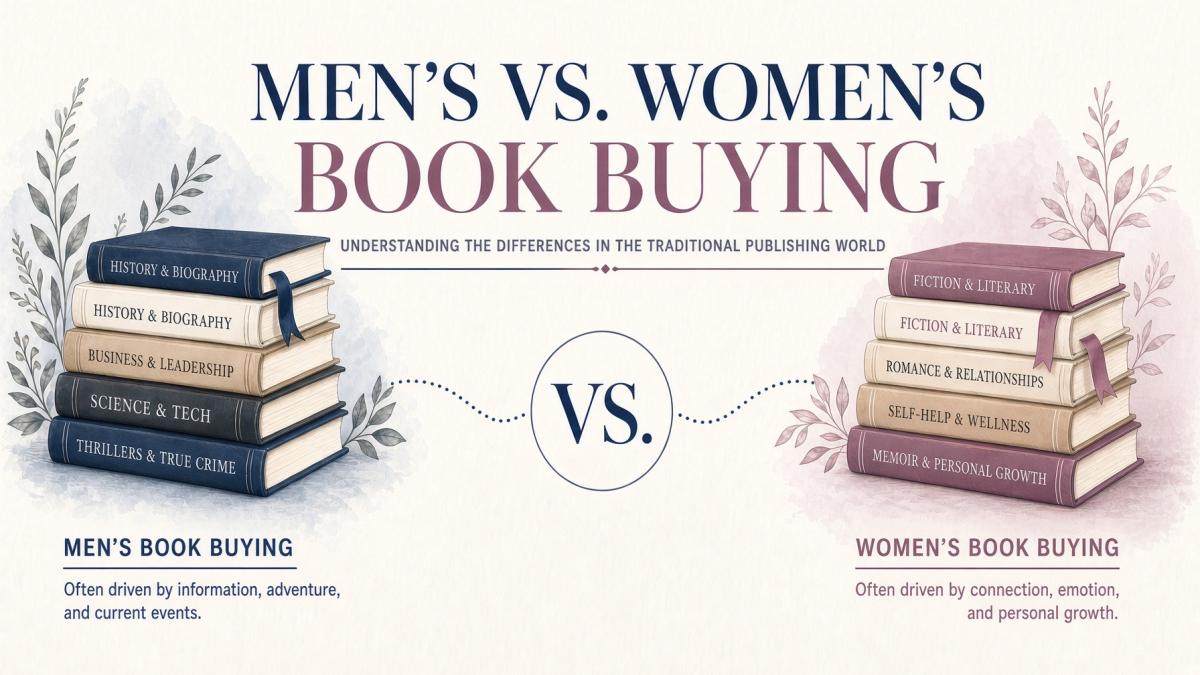
Across more than a million recorded purchases from 2012 through August 2024, NielsenIQ's Books & Consumers survey found that women bought 59 percent of books in the UK. They bought 58 percent of print books and 65 percent of e-books. Audiobooks came out even, half and half. Crime and thriller was the single most popular genre in that long view, about 14 percent of all purchases.
Look at a single recent year, and the picture holds. In 2024, women made 58 percent of all book purchases in the UK, according to NielsenIQ BookData as reported by The Guardian. Men made 37 percent of fiction purchases that year, which means women made about 63 percent of them. Back in 2017, BookData put the fiction split at the same place: 63 percent women, 37 percent men. Nielsen's own look at paperback fiction in 2019 found women accounted for 60 percent of those purchases over the full year and 62 percent in the summer months. The Guardian, citing Nielsen Book Research, has also reported that women outbuy men in every category of novel except fantasy, science fiction and horror.
Men are not absent from the cash register. They buy more nonfiction than women do, 55 percent to 45 percent in that 2024 UK data. The novel, though, is a market that runs on women. It has for a long time. That was true in 2017, and it was still true in 2024. The split is closer to 60-40, or 63-37, than to 80-20. A twenty-five-point gap is plenty large enough to shape what publishers acquire, what they package, and what they put in the window. It does not require a made-up number to matter.
What sells, and who writes it
Buying habits show up on the lists.
In a July 2025 discussion reported by The Bookseller, the BBC's Lucy Proctor noted that 17 of the top 20 bestselling novels at the time were written by women, and that Freida McFadden had written five of them herself. Earlier that year, The Guardian looked at the weekly Sunday Times fiction hardcover bestseller lists and found that only about a third of the authors who appeared were men.
That is not the same thing as saying men don't sell. Richard Osman's novels took the top two spots for the most books sold in the UK in 2024. James Patterson, Harlan Coben, Matt Haig and a handful of other men still move an enormous number of copies, and a lot of those copies are bought by women. Prestige has not dried up either. As of early 2025, men had won the National Book Award for Fiction in four of the previous five years, and eight of the previous eleven Pulitzer Prizes for Fiction. Over the ten years leading up to that Bookseller discussion, seven men had won the Booker Prize compared with four women. The 2024 Booker shortlist was five women and one man. The 2023 shortlist had more people named Paul than women. Awards bounce. The commercial fiction list, right now, does not. It leans female, and it leans hard.
Turn the book over to nonfiction and the lean goes the other way. On the Sunday Times lists in early 2025, men made up 63 percent of the authors on the nonfiction hardcover chart and 70 percent on the paperback chart. Books like James Clear's Atomic Habits keep selling years after publication. If you only watch novels, you will conclude the industry has tilted all the way to women. If you only watch serious nonfiction, you will conclude the opposite. Both lists are describing the same business.
Who reads whom
The more revealing split is not only who buys books. It is which books they will cross the aisle to buy.
In 2024, the Women's Prize Trust published an analysis of Nielsen BookData drawn from nearly 54,000 UK purchases in 2023. For the top 20 bestselling female writers of fiction and nonfiction that year, names like Agatha Christie, Harper Lee, Colleen Hoover, Taylor Jenkins Reid and Lisa Jewell, fewer than 20 percent of the purchases were made by men, and most of those were classics rather than living writers. Harper Lee was the only woman in that top 20 whose books were purchased mainly by men.
The top 20 bestselling male writers told a different story. Women made 44 percent of those purchases. Seven of those twenty men were bought mainly by women: Richard Osman, James Patterson, Prince Harry, James Clear, Matt Haig, Peter James and Harlan Coben.
Women, on the whole, read men and women. Men, on the whole, read men. That is not a slogan. That is what the receipts say. It also means that a male novelist is more likely to pick up female readers than a female novelist is to pick up male ones, which is a strange kind of advantage sitting next to a shrinking pool of men who read fiction at all.
Who works in the building
None of this happens in a vacuum. The people who acquire, edit, and sell novels are, by a wide margin, women.
Lee & Low's 2023 Diversity Baseline Survey, the most detailed look we have at the North American publishing workforce, found that 71.3 percent of staff identified as women. Among executives and board members, the share was 62.9 percent. In editorial, it was 73.6 percent. Among literary agents, it was 77.8 percent. In the UK, the Publishers Association has put the workforce at about 68 percent women. The Bookseller noted that women make up roughly two-thirds of publishing staff, while only two of the five biggest houses had female CEOs.
So the shop floor is female. The very top of the big houses is more mixed. Anyone who says men have been locked out of publishing is overstating it, and anyone who says men still run the novel business from the editor's chair is not looking at the same survey. The people choosing most of the fiction are women, writing into a market where women do most of the buying. That is not a conspiracy. That is a business responding to its customers.
It does help explain why certain kinds of novels find a home faster than others. If your core reader is a woman who reads a lot, talks about books online, and will try a male author without much fuss, you are going to see a lot of books shaped for her. Romantasy did not become a force because a committee declared it. It became a force because the people who actually buy fiction showed up for it. Science fiction, fantasy, and horror still hold a stronger male share than the other novel categories, which is why those shelves have never looked quite like the fiction table at the front of the store.
What I make of it
Alright. Editor hat on.
I don't need a crisis narrative to see the shape of this. Women read more books for pleasure than men do. They read a lot more novels. They buy more books, especially fiction and especially e-books. They will read writers of either sex. Men buy more nonfiction, show up more evenly for science fiction, fantasy, horror, and graphic novels, and mostly stick to male authors when they do buy. The old 80-20 line makes the fiction gap sound like a collapse. The real number, in the country that bothers to measure buying by gender, is closer to two women for every man at the novel register, and it has sat there for years.
For writers, that is useful whether you like it or not. If you write novels, your most likely buyer is a woman. That was true when I started, and the newer figures have not overturned it. If you write the kind of story men have historically shown up for, history, war, science fiction, thrillers with a puzzle in them, you are not writing into an empty room, but you are writing into a smaller one, and you should not pretend otherwise. If you want men to read fiction, somebody has to write books they will finish, put those books where they will find them, and quit repeating a statistic that was never nailed down.
The part that should worry all of us is not that women took over the novel. It is that fewer people altogether are reading one. The NEA's fiction rate is the lowest in thirty years, and the drop is happening on both sides of the gap. A form that loses readers, male or female, does not stay healthy just because the remaining buyers have a gender. Books still need men. They also still have them, in smaller numbers than the think pieces claim and in larger numbers than the rumor allows.
The honest work is the same work it has always been. Tell the truth on the page. Know who is paying for the book. And if a number sounds too perfect to be true, go find out whether anyone ever counted it.
Daniel P. Riley is an indie author, editor, and writing coach with Whimsyland Literary Coaching and Services in Pennsylvania. Find him at whimsyland.org.
Sources
National Endowment for the Arts, Sunil Iyengar, "The Men-Women Split in Reading is Real—and Persists Amid Historical Rate Declines," January 10, 2025.
Publishers Weekly, Jim Milliot, "NEA Finds Worrying Drop in Reading Participation," November 3, 2023 (NEA Survey of Public Participation in the Arts, 2022).
Pew Research Center book-reading survey, 2021 (as reported by Constance Grady, Vox, January 3, 2025).
U.S. Department of Labor, American Time Use Survey, 2023 (as reported by Vox).
Constance Grady, "The viral panic over men’s reading habits, fact-checked," Vox, January 3, 2025 (includes Circana BookScan and Nielsen BookData responses on the 80 percent claim, and the 2017 UK fiction split of 63 percent women / 37 percent men).
NielsenIQ, "One in a million: how Books & Consumers data shapes up," 2025 (UK purchases, 2012 through August 2024).
Nielsen Book, "Soaring Temperatures & Soaring Sales," paperback fiction buyer data for 2019.
The Guardian, Ella Creamer, "Do we really need more male novelists?" May 2, 2025 (2024 UK purchase splits; Sunday Times bestseller gender counts).
The Guardian, "The books world is sexist," March 8, 2018 (Nielsen BookScan, January–November 2017).
The Guardian, "Without women the novel would die: discuss," December 7, 2019 (Nielsen Book Research on novel categories).
The Bookseller, Heloise Wood, "Are men being 'pushed out of publishing'?" July 22, 2025.
Women's Prize Trust, "Gender bias in men’s reading habits still exists," 2024 (Nielsen BookData, nearly 54,000 UK purchases in 2023).
Lee & Low Books, Diversity Baseline Survey 3.0, 2023.