Author Interview with Alex Newman
By Spotlight Admin
Today we welcome Alex Newman as our spotlight author. You can find his profile, including his listed books, at spotlightonindie.com/authors/alex-newman.
Welcome, Alex!
SPOTLIGHT: To start out, please tell us something about you and your writing.
ALEX: I live and work in Asia. I have travelled a lot and lived through many things on my way, from suffering and the challenges of fate, to interesting adventures that are worthy of books in themselves, to the simple silence of temples. I listened to monks, travellers and people whose lives looked nothing like mine. They taught me that the first explanation is rarely the whole one, and that people carry more than they show.
I began writing as a schoolboy, with articles about nature conservation, human rights and cultural heritage. Later came newspaper stories, poetry and work in television. My mother gave me my love of reading and writing. My first romantic adventure book came out in 1994, in a small edition. I wrote my first book for my mother.
The story that began with my first love was about my sweet girl, who was dying of cancer. I wanted to tell her so much that I kept leaving her my thoughts. I wrote so she could live in a beautiful world, in love, silence and peace. Of course, I did not manage to say everything. But a wish remained: to pass words on through the universe. It has stayed with me ever since. I want words to bring people together, whoever they are and wherever they are. I came up with a way to create a new DNA in which words and emotions, letters and feelings are woven together, so that the reader feels them like Braille, something tangible and strong. So that everyone can feel this connection and find their way to one another, and walk toward happiness, even when it seems unreal and magical.
I still write poetry and short stories. Poetry became my road to the depth of words and emotions. Writing has always been my way of reaching someone, of helping us feel our connection and find our way to each other.
I spent twelve years writing The Consent Chronicles. During those years I was also writing other books. Much is still unfinished: stories connected to this trilogy, stories that tell about other characters from the books, even about parallel universes and their links with this one, and other stories that raise important questions I keep thinking about, questions I met on my way or heard from the people I met. Life kept making its own changes, and the book had to wait. Still, I kept returning to the pages where the story came alive, looking into my characters' faces and feeling the gravity of a strange planet. I felt their skin as if it were my own.
SPOTLIGHT: Thank you for that introduction. You mentioned writing poetry, and your introduction has a poetic language to it. What type of poetry do you like to write?
ALEX: Lyrical poetry. I like being able to say “you” and almost hear the other person answer. Sometimes there's only a step between prose and a poem. In “Romanticism… A Sketch,” there are ordinary things at first, coffee, a blanket, soup. Then comes the question, “Is all this really possible?” From there the words start to fall into verse.
I think Eastern literature had a strong influence on me, especially poems by Indian and Arab writers. So did Spanish and French poets. And my sister. I was about fifteen when she asked me to put Shakespeare's sonnets into modern English. My mother sings and writes poetry. All of that found its way into me somehow.
And of course I'm curious. I go around smiling and find something to be happy about in each new day. I'm alive. There's still something new I can do or learn. So, I go ahead and meet new people, explore new projects, and see what else there is to find.
People who read my poems sometimes ask how I managed to write something that sounds like their own words. “That's exactly what I want,” they'll say. I love hearing that. I was trying to get at a feeling of my own, and somehow it was theirs, too.
SPOTLIGHT: You have several books on this platform. Could you tell us the details of your book or series, including main characters, conflicts, themes, and anything else you'd like to explain?
ALEX: Main characters -
In The Consent Chronicles, Vittorio is a man from Earth who wakes in a future without the memories that would tell him who he is. He can sense what another person will decide seven seconds before they do, yet cannot decide who he is himself.
General Mad Seraphin Tale is his love interest. She once married a rich man and lived in a golden cage before she fled. A friend who had escaped slavery himself helped her into the academy, where she rose to officer.
Kael Tardo is the antagonist and creator of Akhet, a technology he made out of love for his mother. His people have bodies like soft, warm glass and can feel the electric field of others.
Dara, the ship's doctor, was enslaved as a child. That is why she insists on a patient's consent, even in an emergency.
The crew also includes an engineer, a linguist who keeps archives so he won't lose the memory of his siblings who died young, and an empath who hears lies.
Setting –
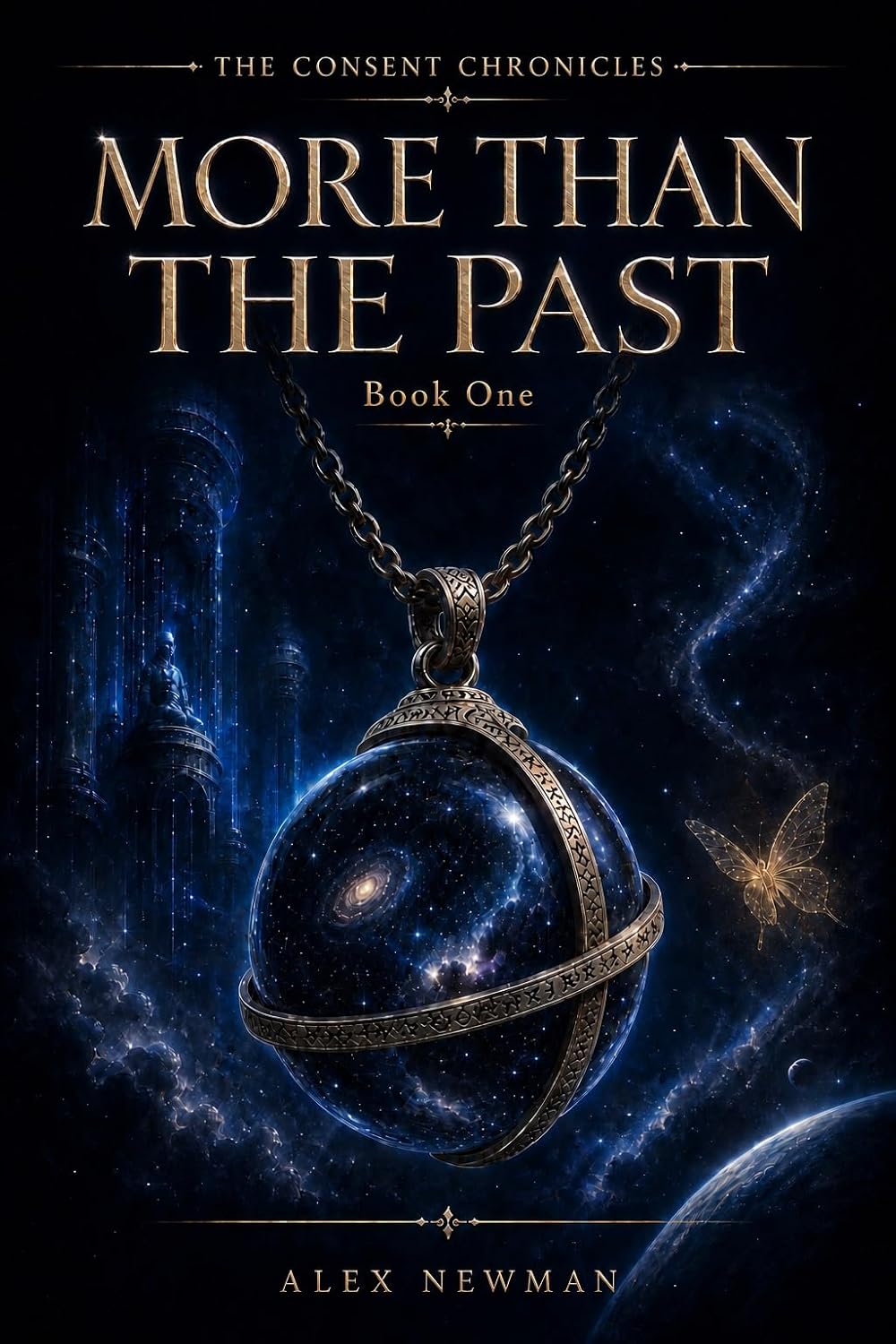
The Consent Chronicles is a space opera trilogy: More Than the Past, More Than Power, More Than Time. It moves between the research ship Ariadne, a fleet nobody can see, and worlds one step from war. There is a desperate evacuation across inhabited systems, and a promise of protection that demands surrender.
Protagonists and conflicts –
Vittorio must choose whom to trust if he is to learn what happened to him. Akhet can change a body, a memory, who you are. It comes dressed as mercy, offering to bring back the ones you've lost and heal what can't be healed. But someone always pays, and the one who pays is almost never the one who signed.
Themes –
The Consent Chronicles asks who gets to say yes when someone can change your memory, and whether anyone has the right to make another person belong to them. It is about consent, memory, identity, trust and freedom. Grief is there, too. If a doctor offered to take away the night you lost someone, would you say yes? That memory also holds a name, a voice, a last promise. The people who take our choices away usually mean well.
SPOTLIGHT: What inspired the books?
ALEX: The Consent Chronicles began with one picture: a man opens his eyes and doesn't know who he is. No screaming, no panic. He listens. His body knows things his mind doesn't, and feels danger before it comes. What kept me at the desk was not the ships and battles, but one person standing next to another, deciding whether to trust him.
MANGO is a romantic suspense novel about Leah, who is grieving her husband, Daniel, when a message arrives from his phone. It draws her into masks, pursuit and stolen identities. Adrian is a stranger who offers her a way out, knows too much about her, and may be the only one who can keep her alive. Following him means chasing the truth about Daniel while risking everything for a man she has just met. The book is about loss, stolen identities, dangerous second chances and love. MANGO is published in seven languages.
Across my books, I return to the moment when someone must make a choice and nobody can tell them what it will cost. The settings change, but trust, freedom, love and the right to choose to remain. I lean toward adventure and romance for future writing.
Perhaps a choice stays with us not only for what it changes, but for what we remember.
SPOTLIGHT: I'd like to step back a bit before we go into more details about the books. An item in your introduction piqued my interest… What did you do in the television industry and what did you learn in that?
ALEX: I started in the props department, making things for commercials and television programs. We worked with stars of every kind, from people just beginning to shine to the ones already blazing away in show business. And then there were the old luminaries. You practically needed a welding mask to look at them.
I was curious, I thought like an engineer, and I liked making things with my hands and leading a team. I tried different jobs and eventually assisted the director on a major film. Then I realized I wanted to help shape how people looked on camera. My partner and I proposed taking charge of what was, at the time, a new kind of department for film and television, and they gave us the chance. We dreamed up looks, made things, went out looking for whatever we couldn't make, and got to see familiar faces and new ones light up. We made beauty. I think that's where I learned to pay closer attention to beauty in women and men, and to respect what each person brings to it. I think it also taught me to accept that other people have lives and wishes of their own.
Working in television taught me to see a scene as I write it. I think about where the light falls, what someone does with their hands while they’re trying to find the right words, and how long the silence lasts before they speak. People often tell me that reading The Consent Chronicles or my romantic suspense novel, MANGO, feels like watching a film. They say, “I felt like I was watching the book.” I always smile at that.
If I had one thing to say to someone who wants to write, I'd probably tell them to get out of the chair and walk around in the world. The world will write you a story in the things you live through. Or it will throw some strange, almost magical light on an ordinary event. Then you can open it up and give other people the pleasure of understanding it a little better. Someone might see more of the world around them, or look differently at a problem or an event they'd walked right past. Talk to people. Get to know what's new and what's old. Keep going.
SPOTLIGHT: Is your first book, the romantic adventure your wrote for your mother, still available? What did you do with that?
ALEX: It came out in a small edition in 1994. I wrote it for my mother, who gave me my love of reading. It was about a boy who finds a way into time portals on an abandoned construction site. I wrote it from a teenager's point of view. I was a restless kid myself. Getting me home was a full-time job. The book was a way of showing my mother some of what I saw when I was out in the world.
There are some similarities to Blake Crouch’s Dark Matter, though I wouldn’t say our ideas line up exactly. In my story, the doors led to places in the same universe. In his, they lead to parallel worlds. But both stories had a lot of doors. I find it fascinating how many doors we try to open in life, and how that curiosity finds its way into what we write. A story gives you room to ask what’s behind the next door. Do you open it, too? And where do you stop?
When I read Dark Matter, I was captivated. I loved how many questions Crouch raises. Some of them stay with you long after you’ve closed the book. I found it a deeply thoughtful novel.
I don't know whether anyone can still find a copy. There may be pieces of the manuscript among my old papers and on some old hard drives. We're talking Norton Commander and Word 1.0 here. I'm not sure I could find a computer to plug those drives into. I haven't gone back to the book in years, but every now and then I go looking for something in the boxes in the back room, see those drives, and think about it. Once I've finished the novel I'm planning for 2027 and the two books about the amulet from The Consent Chronicles and how it made its way to our characters, I might finally get around to bringing that first story back into print.
SPOTLIGHT: How would you describe the type of space opera you wrote in The Consent Chronicles?
ALEX: Oh, I think this question is going to follow me for the rest of my life. I've read the trilogy myself several times, and after more than thirty interviews and all those conversations with readers, I still catch a different flash of light each time. I'm not claiming I've cut a diamond. Sometimes all it takes is someone looking at the same scene from where they're standing.
I think of it as an ethical space opera. It's a demanding thing to write, especially when you're trying to keep a philosophical thread going through the battles and the love stories. But then you find a turn you hadn't seen before, and it takes you deeper into the relationships between people and into what happens between people and the technologies they use.
That’s also how Elissa Mullins saw the trilogy. She thought it might resonate with readers of Ann Leckie’s Ancillary Justice, Arkady Martine’s A Memory Called Empire, Becky Chambers’s Wayfarers, and Martha Wells’s The Murderbot Diaries. These are readers who come to space opera for questions about identity, power, and what makes someone a person.
When we were going through the manuscript, my favorite literature teacher, who always told me I'd become a writer and that she was waiting for my book, compared the trilogy to Dune, The Three-Body Problem, The Expanse, Dark Matter, and some lesser-known works. She called it an ethical opera, too. You have to let yourself sink into that depth and enjoy it. Beyond the beautiful planets and everything happening on them, you start to see the defenses our minds build. There are lines in there, too, like a golden path. They might offer someone an answer, or simply point in a direction without telling them exactly where to go.
I like to stay close to my characters. There's the Ariadne, an invisible fleet, an evacuation, and worlds about to go to war. And then I'll be writing a conversation and one of the characters will practically stand in front of me and say, “Alex, are you serious? Listen. Let me tell you how this feels.” So I sit there and listen. Sometimes they surprise me. Sometimes I recognize something I've lived through.
Someone on a ship that's changing course still has to find the courage to tell another person what they're afraid of. I've held back plenty of things I've written because I was afraid, so I can wait a few seconds while they work up to it. That conversation might change the course of a ship, the fate of a world, or just one person's life. That last one is enough to keep me listening.
SPOTLIGHT: Could you give us a brief idea of the conflict or focus of each book in the trilogy and a summary of each story in general?
ALEX: More Than the Past. Vittorio wakes in a forest with no memory. His body is barely awake, yet it reacts to danger before he understands what it has sensed. I think of that instinctive fear of fire or water, as though it had traveled from our ancestors to our parents and on to us, written somewhere in our DNA. Or a child's cry. You haven't even seen what happened and already you hear a call for help. To find out what happened, he has to trust strangers while he's still trying to work out whether he can trust himself. Imagine someone came up to me and said, “Your real name is Frederick,” and then showed me a hundred convincing pieces of evidence, from my birth to the moment we met. I'd start to sweat. What do you do with a memory you've been given when you know memories can be rewritten?
More Than Power. Kael Tardo built a technology to save his mother. I can understand that impulse. Now a more dangerous version of his invention puts an entire city at risk, and nobody asked the people living there. And the same man is still behind it. Vittorio and Mad find themselves on opposite sides as the choices of a few people begin to determine what happens to whole worlds. Old wounds and loyalties come into play. Some people pass each other like pawns on a board. Others come through the door like a Trojan horse. And feelings, however deep, don't always win when someone has already worked out what they want and who else will pay for it.
Diamonds can throw such a beautiful light. You want to go closer. Sometimes they dazzle us so completely that we open a door into what feels like someone else's mind, as if that mind belonged to a parallel world and we could wash our hands of what happens there.
More Than Time. Neira receives an invitation in the form of a gold mark on her sleeve. She's offered the chance to stop being mortal while still living as herself. It's easy to see what you could gain from an offer like that. It's a form of power, too. And there are people who learn to use it by walking that thin line between mind and soul. I wanted to see what she would ask before she answered. The other characters have their own versions of that choice. How much time do they want, and whom do they want to spend it with?
SPOTLIGHT: What is your main focus in The Consent Chronicles? What do you feel is the most important aspect of the trilogy?
ALEX: For me, it's the difficult freedom to say no, even when the offer of help comes from love. We talk a lot about helping and saving people. We draw lines around ourselves and each other, and then find ourselves at one of those lines wondering how to refuse without hurting anyone, including ourselves. And what do you do then?
Imagine a doctor could take away the night you lost someone. Along with the pain might go the sound of their voice, the way they looked at you, the feeling of their fingers slipping out of yours. What would you be willing to give up? I've felt a hand slip away like that more than once. I stayed with them to the end. Did it hurt? Of course it did. I wanted them to stay, and I couldn't bring myself to turn away. I was more open to them than I'd ever been. At a moment like that, you can hurt someone whose soul is already slipping away without even noticing. I think only an open heart can bring some peace into that moment. It's as if two souls come together for a little while.
That's why Dara, the ship's doctor, matters so much to me. She knows what it feels like when other people decide for you. Even at a patient's bedside, when time is short and the temptation to decide for them is strongest, she tries to hear what they want.
I wanted that question to feel just as deep and honest at any moment in a person's life. Sometimes someone decides something quite ordinary for you, right there at the kitchen table while you finish your coffee. You still have to find your voice and say what you want. And the person beside you has to let you finish.
SPOTLIGHT: I assume MANGO is a completely different world than The Consent Chronicles. You mentioned the similarities in them, but let’s go a bit deeper. Could you tell us more about MANGO?
ALEX: In MANGO, it starts with a phone. Leah gets a message from the number of the husband she believes is dead. There are only a few words on the screen, and suddenly she doubts her own judgment. In The Consent Chronicles, Vittorio opens his eyes in a forest. A branch is about to fall where his head is resting. His body moves before he can remember so much as his own name.
I know that feeling of having to get up, take a step and trust someone before you've understood what just happened. Sometimes the person you most want to believe is the one who says they can give you back what you've lost. Can you still hear yourself when someone makes you an offer like that? Can you live with your own answer? The decision will be yours to carry. That's what the two books share for me. When we're young, a feeling can carry us straight into trust. Later we may find how little we knew about the other person, and how quickly trust can go.
SPOTLIGHT: Tell us something about your writing process and the publishing of your books.
ALEX: The Consent Chronicles began with a man opening his eyes and having no idea who he was. And no, this wasn't me after a party. I wanted him to listen to himself, to the world around him, and eventually to other people. I wanted to stay with him a few more lines and hear what he heard.
In dialogue, I try to listen first. Someone might ask a small question because they're afraid to ask the one that matters. They might make a joke when what they really want is a hug. Sometimes I let them finish the sentence. Sometimes I leave the pause they'd rush to fill.
I write very fast. I often hit the wrong keys because I don't want to lose that moment when I can still feel everything that's happening in the scene. Then I do a lot of revising. I check the pages against the story arc and see where the characters have taken me. I've been known to rewrite a third of a book because I took a character out of the story or wandered away from the plot I'd planned. Sometimes it's hard to bring a book all the way to the end.
And sometimes you finish a whole book in four or five months, in one breath. You fix a few typos afterward, and the editor goes over the rest and barely touches it. They're just reading.
I've said in another interview that the story came into my head like an atom from another universe. The first thing I drew was the medallion, and there was already a story about the creators of worlds. I took it to a monk I know. Sometimes we sit together for hours in silence. Other times our conversation goes wandering through the universe. When I told him the story, he told me to wait before publishing it. How would I know when? He said I'd feel it. By then, someone might need the book and find an answer in it that was theirs alone.
The main thing is to write. Though sometimes all I want is to sit in my favorite café, look out at the lake and sip my favorite cappuccino. Or have a glass of cold rosé. Or white wine. Then I catch myself reaching for my phone, and there I am writing a page or two.
SPOTLIGHT: Do you have other works besides your published books and the poetry?
ALEX: Yes, I write short stories, sometimes in a traffic jam, between workouts, or at the beach at night. Some have found their way into my novels. Others still might. I've thought about putting a collection together. My mother is probably keener on it than I am. She's the one gathering the pieces of paper, the files, and the messages I send to her or to friends.
I like to make something you can step into for a few minutes, the way a photograph can take you back to a moment. In “Morning,” a cat is sitting on a windowsill when a pigeon comes to find out if the people are still asleep. Inside, the couple are waking and reaching for each other, unaware of the conversation outside. I like that tenderness can come into a story through two creatures bickering on a windowsill.
SPOTLIGHT: Do you have any other works in progress or planned?
ALEX: I'm in the final stages of editing a novel I plan to publish in 2027. I don't have a date yet. I'm at the point where I'm polishing it with a cloth, like the bodywork on my car before a date. The title can stay in the drawer for now. I had two working titles, and I still have two names in mind for when it's old enough to get a passport with a real name and a photograph.
A great deal happens in the life of the woman at the center of this book. I wanted to spend time in her world, with her wish to feel safe, the things she has to get past, and the work of becoming independent when society and the people closest to her expect something else. How do you become independent and still draw people closer? How do you reach for someone with kindness, know when to be gentle, put your arms around their soul, so to speak, when there are feelings pulling you the other way, too? I'm interested in how much she can feel beside another person, and how much of her true self she can discover when that person isn't there.
There are also stories I'm working on around The Consent Chronicles. I'd like to follow some of the characters who slip out of sight and see what happened to them before or after the events of the trilogy. Some of those stories reach into parallel worlds and the places where they might touch ours.
SPOTLIGHT: Where can people find any other works or your poetry?
ALEX: The poems? Ha, I don't know when I'll publish them. Maybe I'm waiting for another nudge from the universe, like that conversation with the monk or a call from an editor that I nearly slept through. Many of the poems came with a mood or a feeling and weren't addressed to anyone in particular. Some land like a bowling ball on your foot. With others, you look down and realize you and the sofa are floating near the ceiling. The neighbor downstairs may be stuck to theirs by now.
I spent about a year in a wheelchair. I found a typewriter in my hospital room and wrote poems by the ton for doctors, people in the ward, people about to go home, anybody I met. Sometimes I wrote because I'd been staring out the window feeling low. Sometimes friends stayed and we talked half the night. Even people on the hospital staff would stay and talk. I think it made the room feel a little warmer for all of us.
Maybe one day I'll weave the poems into something, like a basket made from grapevines. There might be a small secret inside. There's a lot of me in those poems. Poetry can open up parts of me that I rarely show.
You've got me thinking with that question, actually. Maybe I'll decide to go ahead and put together a collection of my poems after all.
Readers can learn more about Alex and his books at his Spotlight profile at spotlightonindie.com/authors/alex-newman and at the following links:
· author website: alex-newman.author-pages.com
· All my books and stores: books2read.com/alexnewmanbooks
· Goodreads, BookBub, Substack and Pinterest as alexnewmanbooks.