Interview with Adam L. V. Ellis
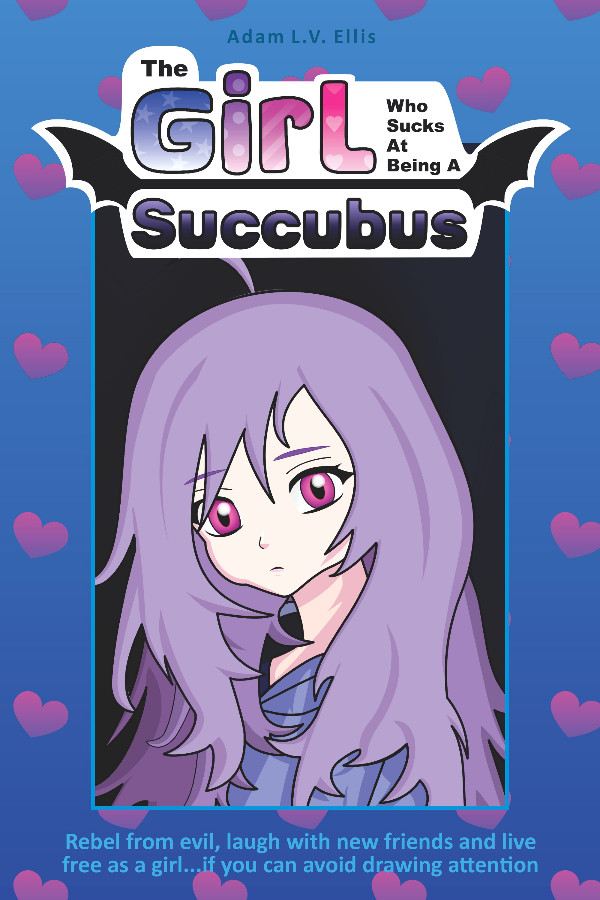
Welcome, Adam L.V. Ellis, author of The Girl Who Sucks at being a Succubus!
Adam L.V. Ellis is a Missouri author who loves creating stories about flawed or traumatized characters growing into heroes and paragons. His favorite story themes include meaning, hope, redemption and the danger and inevitability of vengeance.
With an ADHD mind, he never stops creating or dreaming up new stories. He writes across several genres, such as sci-fi, horror and occasionally fantasy, punctuating his stories with moments of natural levity.
Q: Tell us a little more about yourself, such as any particular details related to your story, other hobbies, special knowledge, etc.
Adam: I guess related to Girl/Succubus, I’ve always found religions and myths fascinating. It’s like the prima materia all stories are ultimately formed from. The Christian fiction about Lilith and the Succubi particularly stood out to me. Both because the legend is that Lilith fell alone, seemingly of her own will, she left Adam to pursue an affair with the devil, and then that Genesis oddly enough describes the creation of woman twice. There is a lot to take from these stories when crafting villains or monsters, but I’ve found there’s also a lot to subvert to create heroes.
More generally, I’ve always been drawn to writing. One of my earliest memories is laying on the floor, drawing and trying to write a story to go along with it. I don’t think I spelled anything longer than 3 letters correctly.
Q: Can you tell us a little more about your story?
Adam: (Characters)
is a terrible example of a succubus, always getting chewed out for committing involuntary manslaughter or traumatizing her targets instead of what her Boss expects her to do with them. So she runs away from her intended purpose and lives in the Bible Belt. She’s generally meek and agreeable, albeit hyper and always seeking mental and emotional stimulation, but she also has a tendency to be greedy.
is a boy with a good heart, though he tends to be a loner and has many antisocial tendencies, at least until he meets Remmy.
is a girl with a reputation and expectation to always be the “perfect” daughter, student, church-goer and heiress of her father’s company. It’s a lot of weight for her. She likes cinnamon and used to whale at gacha games.
is a hard-working Senior who juggles countless part-time jobs to help pay for his sick father’s treatments. Perhaps due to working so much, he’s usually cool and friendly.
is a quiet, nerdy girl with a crush on Yuri who also has a controlling, overprotective mother.
(Setting)
The story is split between small town, contemporary Earth and the harsh realm of shadows, Penumbra, where Remmy was born and the demons were banished after God cast them out of heaven, following Lilith and Lucifer’s rebellion.
Remmy is not very familiar with Earth and often comes across as socially inept, especially to Marianna. Still, Remmy wants to find a place where she fits in and is appreciated more than anything else. Remmy ran away without saying anything to her big sister, so her sister is on the hunt for her. She tends to run and hide from problems she realizes she can’t easily solve.
Remmy struggles with feelings of worthlessness when she fails or is chastised. Unfortunately for her, control of her supernatural abilities is closely tied to self-confidence and the stability of her psyche. So they become more hair-trigger when she’s upset or nervous.
(Themes)
Family curses, inherited sin, being better than your parent, finding your place in the world, the quicksand of sin, karma/reaping what you sow, one kindness can multiply into many, redemption for those who seek it, bonds are strength.
Q: What was the inspiration for this book?
Adam: A friend mentioned having a dream where she was a succubus, but her dream wasn’t erotic or romantic. It was just the weird dream phenomenon where you will know you are categorized as a giraffe, but you aren’t. You don’t have a long neck. You’re just a person who is identified as a giraffe for some reason.
Anyway, I joked about how at first, I’d imagined a failed succubus moping after bungling another assignment. That scene just kept expanding and I said “I think that would actually make an interesting story,” and started writing the first Exhibit (chapter) and plotting the story.
Q: What other books do you have available or are you planning to write?
Adam: This is part 1 of a trilogy I’m releasing in 2026. The whole story was complete before I published part 1, with parts 2 and 3 just needing a bit more polish. Part 2 is expected in summer and 3 in Fall/winter.
Q: Why did you decide to set this as a teen book? (Is there something about that category that attracted you or did it just make sense?)
Adam: It did just seem right. Remmy’s arc is about making her own choices and finding a place to belong, much like how the high school years are for many teens. I envisioned the story with a moe kind of anime style. (Moe being an anime sub-style that focuses on cuter, rounder characters with extra large, extra detailed eyes, heads and hair.) And the succubus curse, in part, makes for a great metaphor for many of the cultural pressures most first experience in their teens. It’s good and fine for Remmy to reject the pressure to sexualize herself before she wants to, just as it is for teens to reject sexualizing themselves, doing drugs or doing social media stunts to fit in. I think all the pressure on teens to grow up faster and faster is very sinister. It’s always good to provide them role models who can rock being weird if it means being true to who they are.
Q: How do the relationships between characters play out over the course of the trilogy?
Adam: A lot of the cast have personal issues that parallel Remmy’s. She meets one girl who is also under a lot of pressure to keep the approval of everybody in her life. Another girl has a strained relationship with her mother. Even Remmy’s sister once wasn’t too different from her. There’s a lot to contrast and compare.
Otherwise, one of the biggest themes is that there is always a path to redemption and rebuilding relationships if one is willing to seek it. If someone isn’t, they will just find themselves sinking deeper into their sins. Nobody is too far gone unless they don’t want to be saved. I’d be curious to know which characters are readers’ favorites after finishing each part.
Q: You wrote that you’ve “always found religions and myths fascinating.” Which religions and myths most interest you or inspire you and how?
Adam: When I was younger, my gateway was Greek mythology. As I’ve gotten older, it’s shifted more toward Japanese folktales and Christianity. Probably thanks to being exposed to anime and games that take inspiration from Christianity, like Death Note, Fullmetal Alchemist and the Xeno series. It could have also been finally finishing a read-through of the Bible after high school.
Q: What research did you do to understand succubus and incubus demons?
Adam: I looked up transcripts of some of the original stories about succubi and incubi and their mother, Lilith. Ultimately, I came to the conclusion that succubi and incubi cannot be demons without divorcing them from their Christian origin. They clash too much with the biblical canon on demons. For example, demons are supposed to be fallen angels, but Lilith, a human turned demon, is often portrayed as giving birth to or creating them. Jesus also speaks about angels lacking the gendered plumbing succubi and incubi would need. Sure, Genesis talks about nephilim. Some believe they were half-angel or half-demon, but there’s no consensus. I have no interest in even touching the nephilim debate. I’m deferring to the New Testament. Maybe someday I’ll have a story idea that tempts me to change my mind, but it’s not happened yet. On my author website, I wrote a blog post going a bit deeper into the process I went through while refining what details needed to change.
In my story, succubi and incubi would be better described as abominations: unnatural, unintended persons who have human minds and emotions but who are pressured to further the infernal agenda. Then, their human forms have been tainted by their mother’s perversions of her body and soul.
Q: On a related note, have you read the Screwtape Letters to gain some insight into demons? Did that have any influence on your writing of this?
Adam: I primarily used the Bible as my resource. For everything else, I usually went with what makes for a more interesting story. For example, the Bible says nothing about the spirit imprisonment concepts from genie stories or the Key of Solomon, but it makes for a better story if demons can be confined to soul jars. That being said, C.S. Lewis also largely stuck to biblical theology, so while it wasn’t an intentional basis, there will be many similarities to his take on the psyche and methods demons use. As an aside, I did reference quite a few stories about demons for a joke or as Easter Egg references, such as Inferno, Supernatural and The Devil Went Down To Georgia.
Q: (I should probably warn you that as a practicing Catholic, I’ve listened to a lot of exorcists and learned a lot about how demons work (and how to stay in the light of Christ to avoid trouble), so I’m coming at this from their reported experiences with some of these questions)… Are there rules for when your demons can attack someone and what are they? (such as opening the door through sin, not being baptized, giving permission to the demons, etc.) How does someone become a target in your world?
Adam: Well, I grew up Protestant and Non-Denominational, so I don’t know if this differs in Catholic traditions. Protestants and NDs generally interpret scripture as describing different levels of demonic attack, ranging from temptation, of which all are subject to. In the middle, there are oppressions and curses for those chronically struggling with sins. At the extreme end, you get to possession. Since the story is set in the Bible Belt, a region dominated by Protestantism and ND churches, I portray demonic attacks based on this interpretation of the Bible.
In this story, demons are normally phantasmal and only capable of whispering temptations but can become fully tangible or possess if given permission by a person or God. Sins, especially if one is not saved, can create spiritual “cracks” that demons can use to oppress or weave curses. One character in part 1 struggled with envy of his rich boss. A demon noticed and exploited this chink in his armor to inflict a spiritual disease, believing it would weaken and maybe break his faith. Instead, the illness only strengthened his faith.
While mostly implied, demons in this story usually patrol cities and look for people deep in a pit of a sin. When the find one, they try to persuade them into accepting possession as a partnership. Once they get the keys, though, they show little care for their slave’s body or life.
Q: Is there a progression of how demonic attacks happen?
Adam: Progression of attacks is not explicitly covered. That falls more into subtext or a byproduct of one sin leading to more sins. That is a strong theme. Each character struggles with one or two of the seven vices. If they give in to it, it will tempt them into more sins and more extreme sins. For example, a character satisfying a desire born from greed could intensify their greedy desires. From there, it could lead them to pride and then to the indolence/sloth to not think things through carefully before acting. Demons moreso exploit and capitalize on this progression than orchestrate it.
Q: What kinds of attacks is Remmy supposed to engage in but doesn’t fulfill and why?
Adam: As a succubus, Remmy is supposed to collect “animus” from men so that her mother can produce new children. Yet, Remmy’s personality and temperament aren’t conducive to that. She is, seemingly by chance, very shy, modest and skittish toward sexual or romantic situations. Given that her mind is essentially human, trying and failing hundreds of times only exasperates her anxiety. It would take being genuinely loved and feeling safe for her to warm up to intimacy.
Q: I can definitely see the Fullmetal Alchemist and anime influence as you mentioned with souls and the animus. I haven’t watched the other two anime series you mentioned, but Inu Yasha deals with souls being taken similar to what you described.
Adam: With Death Note, the Christian influence is more visual than thematic. There isn’t supposed to be a God in the Death Note universe. But I remember some scenes pay homage to religious paintings to reinforce the villain’s messiah complex. Lots of apple symbolism too. You know, in a way, Lilith’s arc and characterization may be a bit inspired by the villain’s in Death Note.
The other is actually a series of games in the Xenogears, Xenosaga and Xenoblade series. They go deep into Christian themes and symbolism.
Q: Do you have exorcists in this because of the demonic references? If so, what research did you find most useful?
Adam: I think the only exorcist or priest I included is in a short story I will be releasing for free to promote part 2. It’s a very brief appearance. Given that I’m coming from a ND perspective, anybody who is saved is technically able to exorcise low-level demons as long as they aren’t foolish about it.
Still, more demons end up getting captured in soul jars than traditionally exorcised. Partly, I think demons getting confined to objects is inherently amusing and provides more opportunities for humor, but it also allows me to remove particular demons from the story for an extended period. Otherwise, they might stubbornly keep coming back.
Q: How are your demons different from real demons? Penumbra from hell?
Adam: Aside from succubi and incubi not being demons, they are fairly close to pop culture and the Bible. They are cunning and decieve by misrepresenting truths. My reading of the Bible is that demons cannot truly lie. The few times demons speak in the Bible, they only distort the truth. For example, Satan twists scripture to Jesus in the desert or tells Eve, she “will be like God.” That was a true statement in the most sinister, misleading way possible. Some Christians may disagree with that reading, but it made the demons more interesting to write, and I think more engaging to read.
I also added a phenomenon that if you know a spiritual being’s true name, you can contact them from anywhere in exchange for revealing your location. For that reason, demons, succubi and incubi usually mince God, Jesus or Christ whenever they have to talk about them. So to them, God is somebody who must not be named. For this reason, nicknames are also especially common for demons, succubi and incubi. Remmy is not actually the name her mother gave her.
The only other thing that comes to mind is there is disagreement whether all demons are united or if they quarrel. In this story, I take the position they are all primarily self-interested and only cooperate as long as it serves their personal interests or they are forced or coerced to do so.
As far as Penumbra goes, it is kind of my take on the pop culture hell. Biblically, hell is a place specifically intended to confine and punish Satan and his followers, not somewhere Satan rules over. Penumbra is actually a place in the heavenly realm where Lilith and Lucifer call most of the shots. It’s also a sort of repurposing of hell from a story I scrapped. Penumbra is less a land of fire and more a harsh, marshy planet with acid rivers. Though, God did fill Penumbra’s upper atmosphere with holy fire to deter fallen angels from trying to return to heaven. It’s populated with extreme flora and fauna like Black Wormwood, an astringent, minty plant used to brew the Penumbran equivalent of coffee or to smoke in a pipe. It’s also home to a special kind of fire breathing ant.
Q: What special powers do demons have in your world and how do they affect events in the trilogy?
Adam: All spiritual beings weave a metaphysical medium called “pneuma”, the Greek word for “spirit”. Angels and demons use it to teleport, fly or work miracles/curses.
Succubi and incubi weave the gendered aspects of pneuma, anima and animus, respectively. Their abilities largely reflect those that their mother developed through frequent contact with fallen angels, down to their strength corresponding to their desires and how desired they are. Their abilities lean toward making them natural tricksters. They are able to glamor things like the opposite sex’s perceptions of objects, exhale paralytics or alter their hair color or the clothing they are perceived in. Since this is a comedy urban fantasy, I usually subvert these abilities to find the humor they bring in everyday situations. For example, Remmy successfully enrolls in school by doodling on a piece of paper and charming it so men see it as an F-1 immigration visa… but a woman will see right through the illusion.
Q: How does God come into this? Does He play a part or is He just a background figure as part of the setting?
Adam: God is not a major character, but he does appear a few times. The bonus chapter for part 2 is a Genesis AU that shows the villain origin stories for Lilith and the Angel of Daybreak, Lucifer.
As an expansion of Genesis, God does appear frequently, even going so far as to place a carefully designed curse on Lilith. Her children’s personalities and temperaments might not seem as unexpected with the full context of that ancient curse.
Q: You indicated that demons are born. How are they born in your world? (The Christian understanding is that demons are pure spirit—fallen angels—and all of them that will ever exist were created by God before the rest of creation in which we live and they can’t reproduce. How do you reconcile this or do you do something completely different?)
Adam: Well, as I said earlier, succubi and incubi are treated as a distinct species from humans or angels/demons. Considering they have the same level of free will as humans do, things like exorcisms or crosses don’t affect succubi or incubi. This ultimately stems from Lilith originally being a human woman. Technically, she isn’t a true demon either. She’s a human who corrupted her body by using it to defile angels. That activity caused their spirits to stain and corrupt each other’s forms. Through all of that, Lilith retains the human capacity for reproduction. Though she does so by weaving anima and animus directly, not by becoming pregnant. She’d never risk any blemishes on her body. Anima and animus, again, are the female and male spiritual essences. When the proper kinds of anima and animus collide, they create the spark of a new life, whether carried within an egg and a sperm or as metaphysical particles. However, the succubi and incubi she creates lack the particular reproductive essence appropriate for their gender.
Q: Since the succubi and incubi in your trilogy are not considered demons, do they have interactions with demons and if so, how does that turn out?
Adam: Lucifer and Lilith are the main leaders, granted part of her curse renders Lilith unable to walk or fly for decades or centuries at a time. So she can’t throw her weight around too often. Their interactions tend to be tense. The devil assigns jobs to struggling succubi. He’s harsh and none of the succubi or incubi like him much, but he’s powerful enough for them hold their tongue and fists.
As far as more nobody, fodder demons, they like succubi much more than succubi like them. They interact a bit like cats. Often they try to ignore each other to not stir things up, but sometimes a demon tries something and there is a tornado of scratching and biting. Remmy, personally, tends to be strongly opposed to every demon she encounters. Largely, because she finds ones who like to raise hell and they think they can push her around. One interesting interaction between them is that succubi and incubi can break a possession by pulling the demon out through brute force.
Q: How does Remmy hide from demons?
Adam: Not very well. If she can avoid making too much of a scene, keep her full name secret and not overuse her powers, she should be able to keep a low profile. But that’s easier said than done for someone who is new to human culture. Not to mention a traumatized succubus. The control of her abilities is closely tied to her emotional and mental state, so anxiety and nerves can do a number on her. She could accidentally stun a male with her breath or release her wings.
Q: In the content ratings, you indicated that there are strong Biblical themes. How do you incorporate the Bible in this–directly or just in summary/themes or some other way? Or is the rating because of the general setting and subject matter?
Adam: It’s a bit of a mix. There are frequent references to Christian figures or topics. There are a few scenes that take place in a church, and you get to hear bits of a sermon. That was one of the trickiest parts to write.
Remmy’s boss also instilled a deep fear of angels and God in her. At the most fundamental level, the story is built on the Judeo-Christian foundation. The story’s moral isn’t to preach that turning to God is the answer to every problem or anything like that, though, but it generally promotes values aligned with Christianity, like loyalty, honesty, integrity, kindness and forgiveness.
Q: Is your purpose to help teach but through story instead of preaching?
Adam: I suppose you could say that. I’m primarily targeting an American, and by extension, an overwhelmingly Christian audience. If an atheist or agnostic finds God, that’s great. More than anything, I just hope it reinforces the cultural Christianity that bound Americans of all faiths together.
Q: [continued from previous question] If so, what lessons do you hope readers take from the trilogy and/or each book?
Adam: That it’s better to be loved than lusted over and that kindnesses and sins both multiply exponentially. Finally, to inspire them to have the courage to stand for what they know is right. I also hope they find amusement and characters they love.
Q: Is there anything else you’d like to share with readers?
Adam: Keep an eye on my social media to catch some free short stories this summer and fall. Also, I’m very friendly to fan creations, so don’t be shy about sharing what this story means to you. Ultimately, storytelling is a partnership between the creator and the audience. Nobody will get the exact same thing out of a story.
Thank you, Adam, for taking the time to answer in such detail all of my questions!
If you’ve enjoyed this interview, be sure to check out the books in his profile here!
You can learn more about Adam and his writing by following him at the following links: