Interview with S. Kirk Pierzchala
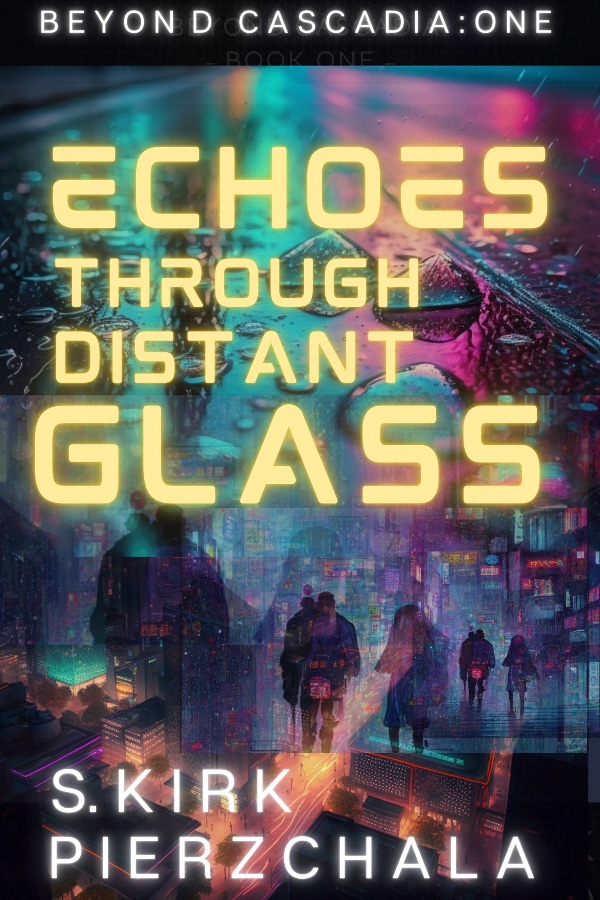
Welcome S. Kirk Pierzchala, author of Echoes Through Distant Glass!
A life-long resident of the Pacific Northwest, S. Kirk Pierzchala is no stranger to moss and damp. She has spent decades crafting fine art, weaving stories and creating children.
Her acclaimed short stories and non-fiction essays have appeared in both regional and national publications.
The Beyond Cascadia series showcases her love for the Northwest and her concerns about mankind’s future, as well as her drive to tell stories that resonate with relatable themes that are both intimate and universal.
Follow her creative journey at https://www.skirkpierzchala.com!
Q: Tell us a little more about yourself, such as any particular details related to your story, other hobbies, special knowledge, etc.
SKP: I was homeschooled in the Pacific Northwest. I spent much of my childhood reading nearly anything that came my way, and by age 13, was writing short stories and a (very much failed) epic fantasy. Even though I wrote a lot through my high school and university years, I gave it up when my kids came along, and I focused on homeschooling them. When I resumed writing in 2016 or so, I at least had a lot of reading under my belt and a pretty big pool of life experience to draw on, which of course wasn’t possible when I was younger. I think this has helped me jump back into the writing scene with a more mature style.
In addition to writing, I am an artist and am toiling away in fits and starts on a graphic novel of my first book, “Echoes Through Distant Glass”.
Q: I’d love to know a little more about homeschooling and writing… How do you schedule writing while homeschooling?
SKP: Honestly, it was pretty hit-or-miss! I had a notebook for jotting down story ideas and scene fragments, but it wasn’t until the kids were older, about nine years ago, that I began to seriously write short stories and some novella outlines.
Q: Do you incorporate writing into the lessons?
SKP: I found that assigning creative or fiction writing was a great way to instill writer’s block in my kids! So, instead, I kept their writing assignments to bare essays and so forth. Now, they do more creative projects on their own, but they are very hesitant to share them with me. Not sure why.
Q: Introduce us to your characters in Echoes Through Distant Glass and the Beyond Cascadia series–who they are, their backgrounds, interests, personalities, etc.
SKP: The Beyond Cascadia series has a pretty big cast of characters:
American regular-guy hero, Owen MacIntyre, who has a desk job in cyber law enforcement, working in what is basically a surveillance state. He likes outdoor activities like hiking and fishing. He is a ‘natural law’ type of good guy who doesn’t go to church but is open to dating a Christian girl, even though his supervisors don’t actually approve.
Other important characters are Francisco Chen and Tomas Chen, two brothers who are members of the global super-rich elite. Francisco is a genius who has lots of dangerous secrets to hide, and Tomas is kind of clueless. Their very complex relationship ends up profoundly impacting the geopolitical currents shifting about in the world I’ve built.
The series starts with Owen MacIntyre confronting Francisco Chen, and his brother Tomas, in a narco-terror plot against the U.S. The more he gets to know the brothers, the more complicated and dangerous things get. Over the course of his career, Owen ends up confronting many antagonists, including Hayden Singer, who helps orchestrate a Progressive political coup on the West Coast, and Chan Daiyu, who wants to subvert the U.S. space program. Did I also mention that, due to the hazardous nature of his encounters, Owen is gradually becoming a cyborg?
Q: What inspired the books?
SKP: There is likely DNA from all media I’ve ever consumed buried in my books, but if I had to pick two inspirations, I’d say Ridley Scott’s “Bladerunner” and some of Dostoyevsky’s novels, particularly The Brothers Karamazov. That doesn’t mean my novels are in any way as heavy as that, but I do have some serious sprawling family drama in there.
Q: You said Owen is in cyber law enforcement. Can you detail what that involves in your series and maybe describe the work Owen does specifically?
SKP: In book one, Echoes Through Distant Glass, he starts out at a desk job where he works for the authorities to monitor and regulate the use of illicit tech. The government is authoritarian and strictly monitors the internet, etc., although of course there are always ways around these kinds of regulations. Consequently, Owen has a ‘black book’ of hackers and experts in illicit hardware that he can consult when needed, which comes in handy in the course of some investigations.
Q: Who are the antagonists in your story?
SKP: In book one, the first villain Owen encounters is Francisco Chen, who’s been hired by rogue Chinese government agents to stir up the U.S. populace prior to an important election. In the second half of book two, Eclipse Rising, Hayden Singer supplants Chen as a threat, as Singer is working with a Progressive political faction to seize control of the Western United States.
Q: You mentioned that Owen is becoming a cyborg. Can you be more specific in the hazards he faces?
SKP: Francisco Chen is not pleased with Owen’s interference with the narco-terror plans and orders a reprisal that leads to a life-long impairment. But since the injury is treated with high-tech equipment, he also gains some extremely useful abilities.
Q: How does cybernetics incorporate into your world in the Beyond Cascadia series?
SKP: While Owen has prosthetic devices to restore lost functions, people also have the options to get brain chip-implants that enhance cognition, etc., although academia has ruled against the use of such devices for students.
(In this world, cybernetics enhance abilities but are hackable. For example, eye injuries are corrected with special visors that provide new ways of seeing, including scanning, magnification, internet access, etc. Brain implants can increase IQ or provide communications technology direct from the brain. The secret communications aspect becomes a big part of the series.)
Q: How does one become a cyborg?
SKP: Injury or choice, depending on the circumstances!
Q: What are the implications or significance of becoming a cyborg? Does the technology allow people to be controlled or is there some other risk?
SKP: With enhancement of some abilities, there is usually a trade-off. Since Owen’s multi-use visor is wired into his brain, there can be side effects due to inflammation. It is also vulnerable to hackers. Other brain implants have even more dire side-effects, which I explore in books six and seven.
Q: How does Owen get to know the brothers? Can you tease us with some of the events?
SKP: Certainly! When Owen’s superior orders him into the field to investigate what the Chen brothers might be up to, he makes contact with Tomas at a trendy night club, and they are soon thrown together for several days. Tomas is not at all what Owen expected him to be based on data gleaned from the internet, and their relationship becomes far more complex.
Q: You mention some sprawling family drama – how sprawling? You also mentioned that the first book starts approximately 50 years in the future, but what is the time period of the book or the planned series?
SKP: Much of the drama centers on the Chen family, and some of that is told through flashbacks in book 3. From the beginning of the series to the end spans about twenty-five years, so it wraps up in the late 2090s! The principle characters age, some have regrets, others watch their children grow up and carry on to embark on their own adventures.
Q: “The more he gets to know the brothers, the more complicated and dangerous things get.” Why? What kind of struggles/conflicts do they face?
SKP: While Owen’s main assignment is to defend the U.S., he’s also disturbed by the abusive control that Francisco has over Tomas, and furthermore uncovers evidence that Francisco has been involved in some illicit biotechnology experiments on his own family. Book three deals with both brothers confronting their toxic relationship.
Q: Why wouldn’t Owen’s supervisors approve of him dating a Christian girl?
SKP: For decades, the authorities persecuted or at least harassed organized religions and interpreted the ‘separation of Church and State’ as strictly as possible. But Owen’s Captain, Greg Park, is secretly tolerant of Christianity and turns a blind eye to Owen’s ‘fraternization’.
Q: What other books do you have available or are you planning to write?
SKP: The Beyond Cascadia series has six volumes published so far:
Echoes Through Distant Glass
Eclipse Rising
Solitude of Light
Harshest Dawn
Stare at the Sun
Shadowminds
The final volume, Scent of Far Lotus, is underway and I hope to release it before the end of this year.
Solitude of Light, which continues the story of Tomas and Francisco, won a Catholic Media Association Book Award in 2023. Even though it is an openly Catholic work, I wrote it with as little “inside baseball” as possible, instead focusing much more on conflict and the psychology of the characters, so that even non-religious readers can enjoy it.
Q: How are the books in the series organized? Is there a different set of antagonists in each book?
SKP: The stories are pretty linear, except for book three, which has a lot of flashbacks and covers a much longer chunk of time.
The antagonists kind of overlap, or wax and wane according to whether they have setbacks in their schemes or not. Or if they get what’s coming to them. 🙂
Q: Is each book a full story with a beginning, middle, and end; or are they parts of one big story with simply logical cutoff points? I think I’m safe to assume there’s a series plot, but I’m curious about the structure of it.
SKP: There are continuous themes and recurring characters, but I would not say there is a very distinct plot from beginning to end. And yes, each volume has a beginning, middle and end! While some events do carry over between books, I kept each volume more or less contained. If a reader was marooned on an island with only one book from the series, they wouldn’t be devastated or left hanging at the conclusion! But, that being said, there is a promise made early in the series which comes to fruition in the finale.
Q: Do you have any other plans for the characters after this series is done or will you be moving onto something completely new?
SKP: I definitely have some ideas for spin-off novellas set in the same universe! But I also have a lot of shorter pieces I’d like to get to, and a YA sci-fi trilogy that I need to revisit. Also that graphic novel based on book one!
Q: Do you think you’d ever write something more overtly Christian or stick to more subtle undertones for a broader audience?
SKP: What a great question! Book three, Solitude Of Light, is already overtly Christian, and book seven will be also. That’s unavoidable because of the setting. I’ve also had some Christian-flavored fiction published in Silence&Starsong magazine and Incensepunk magazine, so that’s really fun. But I would also like to challenge myself with something more subtle– as you say, for a broader audience. I am eager to explore the different ways to tell a meaningful story!
Thank you for answer all the questions and helping us understand the world you’ve created!
Check out S. Kirk Pierzchala online at the following links and check out her books on her profile here!